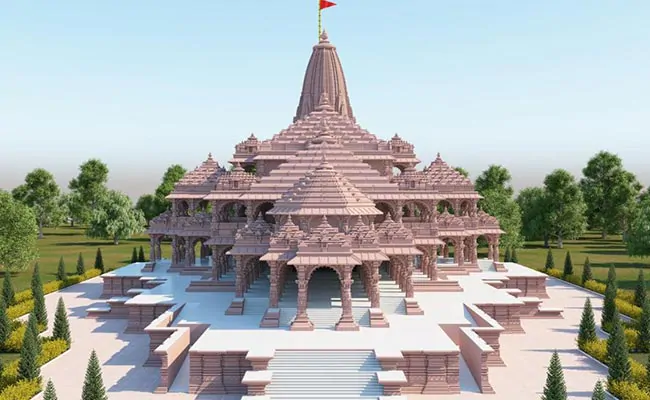
The history of the Ayodhya Ram Mandir is centuries-old. The temple is built on the site of the birthplace of Lord Ram, one of the most revered Hindu deities. The temple was demolished by the Mughal emperor Babur in the 16th century and a mosque was built in its place. The mosque, known as the Babri Masjid, stood on the site for centuries until it was demolished in 1992 by Hindu nationalists.
The Ayodhya dispute has been a contentious issue in Indian politics for decades. The dispute revolved around the ownership of the site where the Babri Masjid stood and whether it was the birthplace of Lord Ram. The dispute was finally settled by the Indian Supreme Court in 2019, which ruled in favor of the construction of a Ram Janmabhoomi temple on the site. The construction of the temple was undertaken by the Shri Ram Janmabhoomi, a trust formed by the Indian government to oversee the construction of the temple.
Ram Mandir Ayodhya Controversies
Controversies surround the temple, including allegations of donation misuse, sidelining of activists, and politicization by the BJP. Historical disputes date back to the construction of the Babri Masjid in the 16th century, which was demolished in 1992, leading to inter-communal violence.
Controversies also involve alleged donation scams, sidelining of major activists, and politicization by the BJP. The consecration ceremony faces objections from some religious leaders, while the temple’s construction has been criticized for its design and alleged Muslim involvement.
The “Mandir wahi banayenge” slogan, meaning “The temple will be built exactly there,” has been a central theme in the Ram Janmabhoomi movement and signifies hope for the construction of the temple. The slogan has become part of cultural expressions and political discourse.
The highly anticipated Hindu temple at Ram Janm Bhumi is reported that the inauguration will take place on January 22, 2024, with Prime Minister Modi doing the honors for this modern temple in India. Ayodhya, where the temple is located, is the birthplace of Shri Ram, making it a very sacred place in India.
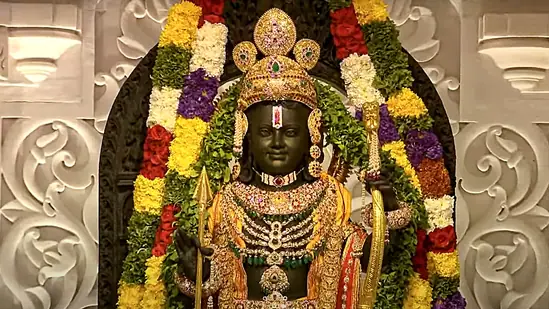
Ram idol statue carved out of a 3-billion-year-old rock
The idol of infant Ram by Mysuru sculptor Arun Yogiraj that will adorn the sanctum sanctorum of the temple at Ayodhya has been chiseled out of a three billion year old rock.
This was stated by C. Srikantappa, UGC-emeritus professor, Department of Earth Sciences, University of Mysore, here on Thursday.
He said geologically rocks around Mysuru form part of the Archaen Dharwar craton and the basement rocks exposed around Mysuru are sialic in composition, termed as Peninsular gneiss. U-Pb isotopic studies of zircon grains in gneissic rocks gives an age of three billion years. suggesting that they are the oldest rocks exposed in southern Indian.
He said these rocks are well exposed around the town of Sargur towards South West of Mysore and hence the name Sargur Schist Belt has been coined. Dr. Srikantappa said that based on extensive geological, petrological, and geochronological studies carried out by the Department of Earth Science, University of Mysore for more than three decades, it has been found that the rock used to carve the idol of Sri Ram Lalla is the oldest rock from south India. The rock was taken from an active quarry in Guggegowdanapura in Mysuru district and similar rocks are found in other parts of India as well, said Dr. Srikantappa.
Gift to Ram Mandir
A huge 108-foot-long incense stick was created in Vadodara. Weighing 3500 kg, it took six months to create and cost over five lakh. The incense was lit by Sri Ram Janmabhoomi Teerth Kshetra Trust’s Mahant Nritya Gopal Das. Prepared using cow dung, ghee, essence, herbs, and flower extracts, it is expected to burn for over a month. It is also claimed that the fragrance will reach a distance of 50 km.
A man hailing from Hyderabad prepared a laddu to offer at the Ayodhya Ram Temple. The sweet weighs 1265 kg.
“A diamond merchant from Surat has made a necklace on the theme of the Ram temple using 5000 American diamonds and 2 kg silver. 40 artisans completed the design in 35 days,” ANI tweeted.
Vishwa Hindu Parishad President Alok Kumar handed over a silk bed sheet depicting the Shri Ram temple to Anil Mishra, ‘Yajman’ of Shri Ram Temple. Kumar said that the bed sheet was created by a silk manufacturer from Tamil Nadu.
From Nepal, the land of Sita: More than 3,000 gifts, including silver shoes, ornaments, and clothes, have been sent from Janakpur, believed to be Sita’s birthplace. These offerings symbolism a warm embrace of the divine couple across borders.
A 2,100-kg bell, specially crafted, will soon resonate through the temple grounds. Its deep, soulful clang will serve as a call to prayer and a symbol of unwavering faith.
A unique clock, displaying time in eight countries simultaneously, has been gifted. This symbolizes the universal appeal of Lord Ram and the unifying power of faith across cultures and continents.
Renowned artists and artisans have contributed their talents, creating exquisite murals, sculptures, and carvings that adorn the temple. These masterpieces speak of dedication and a desire to beautify the abode of the divine.
Countless volunteers have toiled tirelessly, offering their time and skills to the construction effort. Their selfless service highlights the immense dedication that fuels this monumental project.
Millions of devotees from across India and the world have donated generously to support the construction. These contributions, big and small, reflect the collective spirit of a community driven by faith.
A devotee from Lucknow on Friday handed over ’56 bhog prasad’ that would be offered to Ram Lalla ‘first’ after the Pran Pratishtha ceremony in Ayodhya on January 22.
One of the world’s most expensive Ramayana has reached the Ayodhya and is worth one lakh and sixty-five thousand rupees. Manoj Sati, a bookseller who reached Ayodhya with the Ramayana to attend the Ram Temple event, told ANI, “We have reached here with our beautiful Ramayana here in the tent city of Ayodhya. It has so many qualities and is the world’s most expensive Ramayana. You can say the most beautiful Ramayana is in Ayodhya. Its worth is Rs 1.65 lakh.” It has a three-floor box, like the Ram Mandir being built with three floors. The ink for the book has been imported from Japan. It is an organic ink. The book can last for 400 years.
As Ayodhya gets ready for the Ram Mandir consecration ceremony, gifts from all over the nation are pouring in. Gorgeous items like a 500-kg iron-copper ‘nagada’ and the ‘Onavillu’ bow, as well as bangles adorned with images of Lord Ram and 56 different types of ‘petha’, are among the many gifts that the city is receiving. Also featured in the list of gifts for the January 22 event are special perfumes from Kannauj, 500 kg ‘kumkum’ leaves from Amravati
An elderly couple, Satya Prakash Sharma and his wife Rukmini Sharma, made the 400-kg lock. A resident of Aligarh, Satya passed away recently. His wish was that the lock should be gifted to the Ram temple in Ayodhya.