
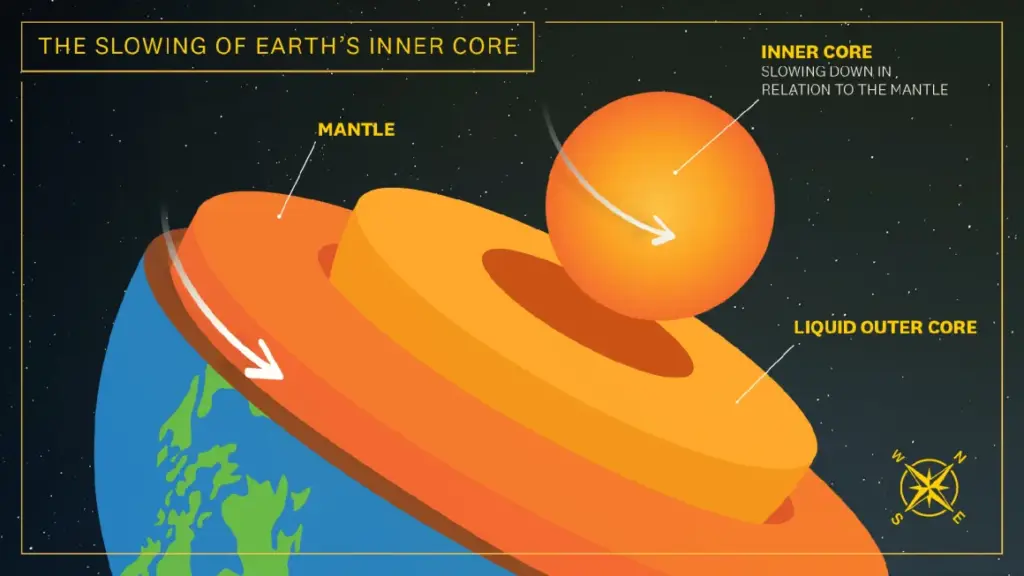
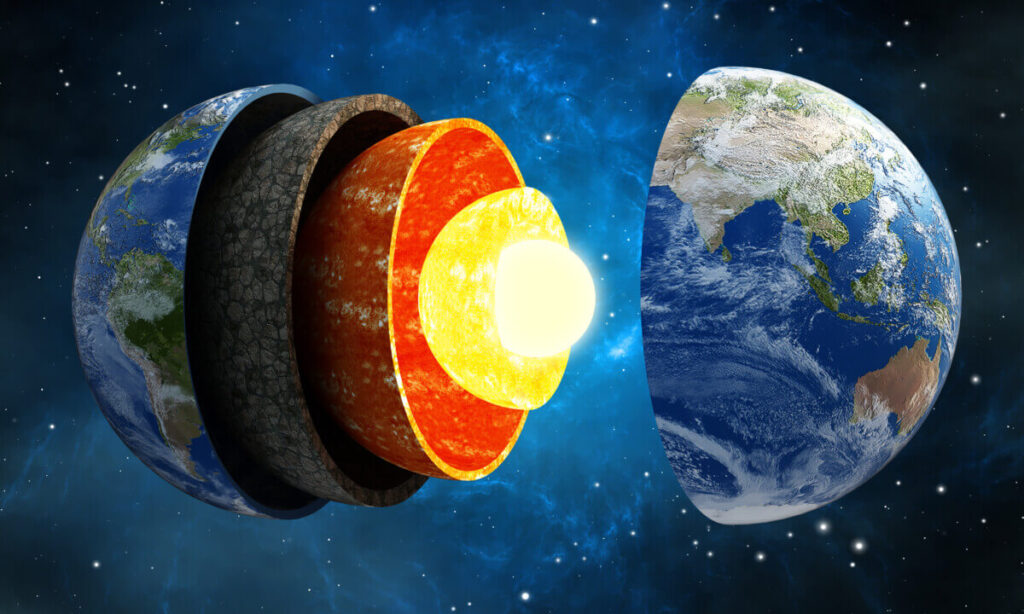
Latest research by scientists has revealed that the rotation speed of Earth’s core is slowing down dramatically and has even reversed. The inner part of the planet can be divided into three different layers: crust, mantle, and core. Several theories suggest that Earth’s core is rotating independently of our spinning planet.
Earth’s core
Earth’s core is the hottest part of the planet, equivalent to that of the Sun’s surface. The core is buried around 5,180 kilometres deep inside the Earth and consists mainly of iron and nickel. The inner core is surrounded by a liquid metal outer core, which acts as a barrier with the rest of the Earth.
Days on Earth may be longer
Scientists have found that the rotation of the Earth may be slowed down and it may make our day a little bit longer. But this change may be so miniscule that there may be a difference of milliseconds and we wouldn’t even notice it. Scientists argue that
as backtracking occurred in the last 40 years, the possibility of such a massive object undergoing such an extreme change should be much less. However, the team of researchers has also said that they have the “most definitive evidence” that the inner core is indeed backtracking and moving slowly.